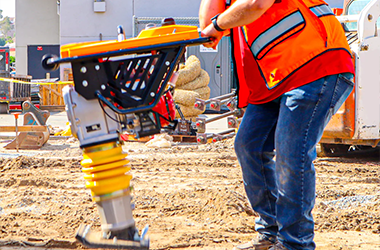

What Is The Actual Work Of Tamping Rammer In Construction?
You know that feeling when you finally understand why a tool exists, not because someone told you, but because you saw something go wrong without it?
That’s me and the tamping rammer.
I had always thought it was just another noisy, dusty, arm-bashing machine that was dragged out for narrow trenches and then forgotten. But after a few painful (and expensive) lessons on job sites, I had my “a-ha” moment.
So let me tell you what I’ve found. No textbook talk. Just real talk from someone who sells these things, and also sees them saving floors or seeing people skip them and cry about it later.
“But the ground looks fine” – Yeah that’s a trap
Imagine that. You have a nice patch of gravel or backfilled dirt. You step on it. Solid, huh? Maybe you even drive a little cart on it.” No sweat.
Here’s the dirty secret:Loose fill is a fibber.
That’s the surface grains “lock together” a little and that feels firm. But below? Bubbles of air. Gaps. There are little pockets of laziness. The moment you pour concrete or lay down heavy machinery that ground says “nope” and starts to sink. Not everywhere, only in the soft spots. And this is the way you end up with cracked slabs, sunken sections and doors that don’t close anymore.
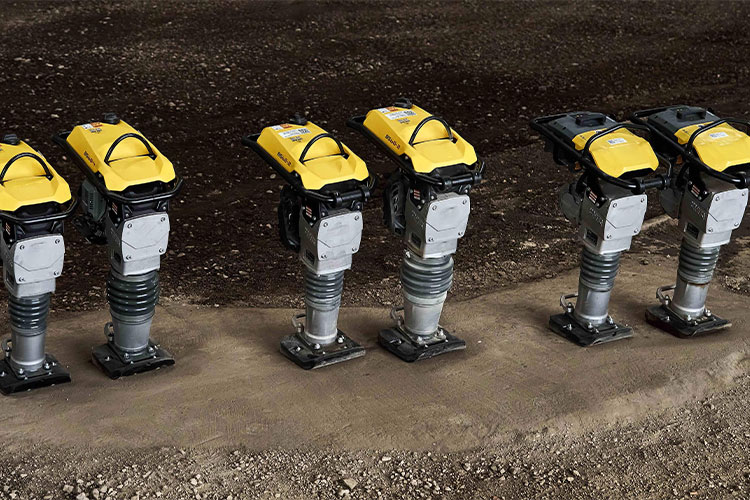
A tamping rammer walks over that lie and punches it in the mouth. It eliminates air pockets, jams the soil grains into a tight embrace and creates a foundation that actually stays put.
I recall one warehouse job where the contractor swore the backfill was compacted enough. “We brought it over in a pickup,” he said. I got our little tamping rammer and ran it over a 3 foot section and the ground sunk almost two inches. His face turned white. That’s two inches of future slab settlement we just avoided.
When a plate compactor isn’t enough
Now some of you might be saying, “Can’t I just use my plate compactor? “It’s easier for the arms.”
Fair enough. And yeah, the plate compactor is great for big open areas. Driveways, large slabs, asphalt patches. But they are most effective on granular soils and on shallow lifts.
But a tamping rammer is different. It delivers a big, low frequency punch. A plate compactor is like a finger that taps quickly – good for smoothing the surface. A tamping rammer is like a heavyweight boxer giving a slow, deep thump.
That thump goes down way down, sometimes 2 or 3 feet depending on the soil. Great for trench backfill, around pipes, besides foundations or where ever you need to compact in confine spaces.
It’s a pipe trench. His plate compactor couldn’t do the job, and he called me once, mad. “Have you got a rammer?” I said. “No,” he said. I said, ‘Go on, have a go. You’ll feel the difference in your boots.” A week later he rang back, half laughing, ‘My boots felt it. But the ground don’t move no more.
I had a “oh no” moment that made me a believer
Let me back up to that job I was discussing earlier.
We were laying an industrial epoxy floor – expensive stuff, the kind that requires a near-perfect concrete slab. The base was a mixture of clay and gravel, backfilled around some utility lines. The foreman was not going to ram any more. “Just pour the concrete, it’ll be fine,” he told me.
My gut said no. I had seen too many epoxy floors fail due to the slab beneath cracking. So I rented a rammer (before I worked at the factory) and spent another two hours tamping every square inch of that trench zone.
The foreman rolled his eyes. The crew joked about “the rookie with the jackhammer.”
Cut to: six months later. Another part of the same building, different foreman, decided to skip tamping to save time. Guess what? Cracks. Big ones. The epoxy peeled off in sheets. Cost them more than the entire tamping rental budget for the year.
That’s when I stopped thinking of the rammer as a noisy nuisance and started considering it cheap insurance.
Where can a tamping rammer really excel? (Spoiler: tight spots)
You don’t use a rammer in a giant parking lot. That’s what rollers are for. But here is the short list of where a rammer is the tool:
Trenches for pipes or cables – you can’t get a roller down there, and loose backfill will settle around the pipe and snap it over time.
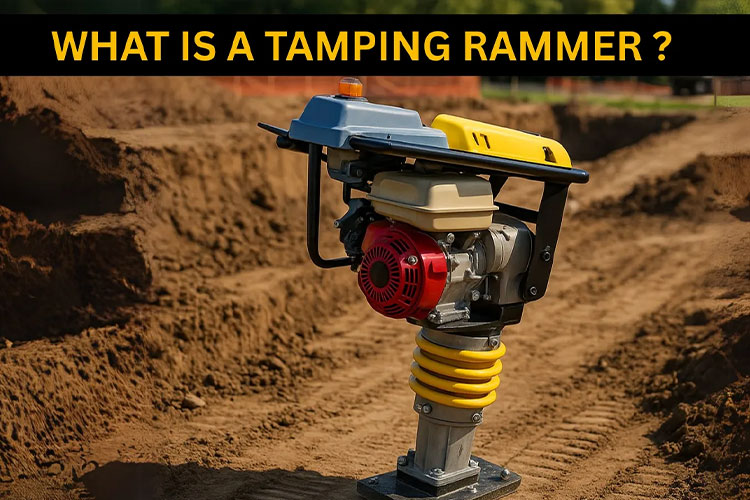
Edges need love too, around manholes and foundations. A plate compactor won’t get close enough.
If your soils are heavy in clay, rammers know how to get clay to behave. Plate compactors just dance on top.
- Small repair patches – when you cut out a bad section of the floor and need to compact the base before repouring.
And my personal favourite: under concrete slabs to support heavy racks or forklifts. Skip the rammer there and you’re basically hoping physics takes a day off. Physics never has a day off.
Operator comfort: A little rant (real talk)
Okay, I’ll be honest: tamping with a tamping rammer is not a spa day.
It goes hum. It’s a noisy place. Your hands may feel tingly for an hour after. I’ve seen rookies do one for ten minutes and look like they’ve arm wrestled a gorilla.
But here’s the deal – modern rammers have come a long way. Better springs, better vibration isolation, some even have padded grips. And you can buy anti-vibration gloves for twenty dollars.
Would I rather push a button and have the ground magically compact itself? “Sure. But until then, I’ll take a little arm buzz over a cracked floor any day.
My advice: take breaks, wear earplugs, and don’t be a hero – let the machine do the work. Your shoulders will thank you.
The bottom line (not concluding with “in conclusion”)
“What’s the main role of a tamping rammer in construction?” If people ask me that now, I don’t talk about pounds per square inch or depths of lift.
I say: It stops the earth from lying to you.
It gives you a foundation you can trust. It saves your concrete, your epoxy, your tile, your time, your rep. And yeah, it’s a pain to work with. But so is a jackhammer when you have to bust out a failed slab.
So next time you’re preparing a site, particularly if it’s for industrial flooring or any slab that has to take loads, don’t just look at the surface. Feel it. Better yet, ram it down and notice the difference.
Got a funky soil condition or a tight corner you don’t know about? Text me. I love all that nerdy stuff and I have probably seen your problem before.